Emmanuel Claude
What is this challenge in Episode 6 of Take Off about?
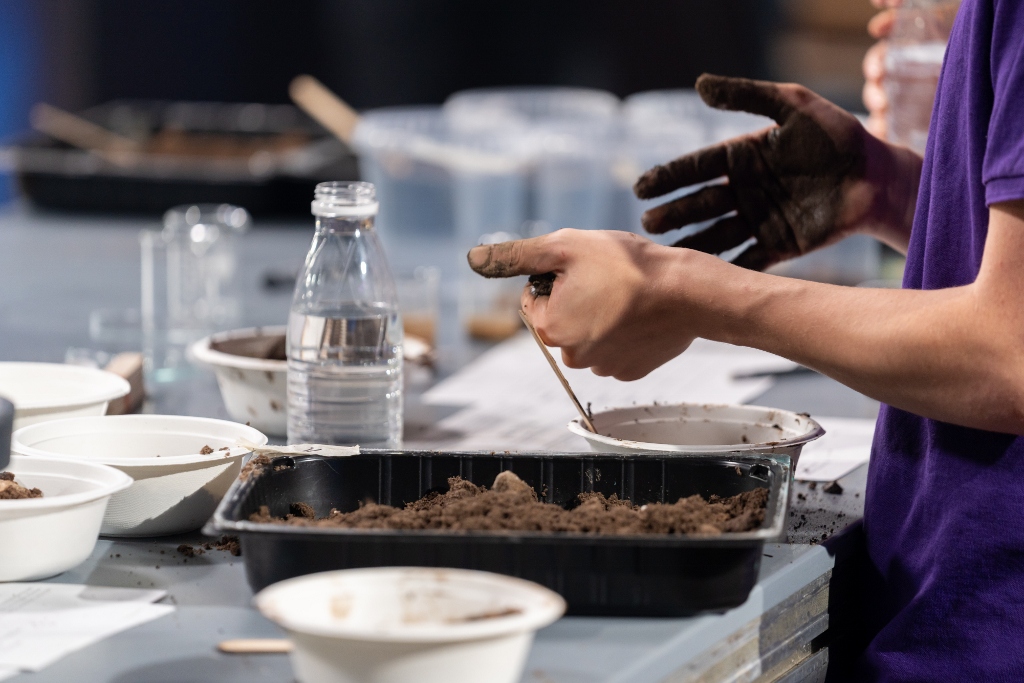
In this challenge, teams compete against each other to scientifically evaluate five different soil samples. The goal is to rank the soils according to their quality and fertility — from the best to the poorest soil.
The teams can carry out various tests to examine soil properties:
- pH value: shows how acidic or alkaline the soil is.
- Color assessment: indicates how much organic matter or carbon it contains.
- Earthworm count: a high number of worms suggests a healthy, fertile soil.
- Consistency test: shows the proportion of sand, silt, and clay.
Based on these tests, the teams must assess each soil and arrange the five samples in the correct order according to quality.
Want to test the quality of your own soil? Here’s how:
The following observations will help you:
1. Soil texture:
A particularly important indicator when evaluating soil quality is soil texture, meaning the distribution of fine soil components, especially clay particles.
If there are too many sand particles in the soil, water drains through too quickly and washes away many nutrients. If the clay content is too high, however, waterlogging can occur, which is also harmful to plants.
In practice, soil texture can be determined quite easily and with sufficient accuracy using the so-called finger test:
Lightly moisten the soil, then take a small amount and form it into a ball between your hands.
- Does it fall apart immediately? Then the sand content is high.
- Does it hold together? Then try rolling it into a small “sausage.”
- Does the sausage break after just a few centimeters? Then the soil mainly consists of sandy loam: this mixture is excellent.
- Does it only break at around 10 cm? Then it is more likely pure loam.
- Can you form a ring with it? Then it is clay or clay-rich loam.
The following graphic can help you classify your soil texture correctly:

Credits: GROW Observatory
2. pH Value:
A neutral soil has a pH value of 7. To check whether soil is acidic, neutral, or alkaline, you can mix a small soil sample with water and test it using universal indicator paper (pH test strips), then compare the color change to the pH scale. Slightly acidic to neutral soil (pH 6–7) is optimal for most plants. However, this also depends on how the soil is being used.
3. Darkness / Organic Carbon:
Here, you simply observe the soil color: the darker, the better. Dark soils contain a high amount of organic matter (made up of leaves, roots, animal remains, microorganisms, and humus). This benefits plants because it improves water retention and increases nutrient availability.
4. Earthworm Population:
You can sift the soil or search through it by hand. A large number of worms indicates healthy soil.
In summary: Dark, slightly moldable soil that contains many worms and does not have an overly alkaline pH is very fertile.
Good soil, bad soil – what does that actually mean?
Soil fertility describes the soil’s ability to supply plants and microorganisms with the nutrients and water they need for growth. This ability can be evaluated in two ways: either by analyzing the soil properties that determine fertility, or by observing how effectively the soil fulfills its fertility function.
A particularly important indicator of soil quality is soil texture, meaning the distribution of fine soil components, especially clay particles. In practice, soil texture can be determined quite easily and with sufficient accuracy using the so-called finger test.
The pH value describes the soil reaction and reflects the ratio of H⁺ and OH⁻ ions in the soil solution. In our regions, soil pH typically ranges between 3 and 7.5. If the soil is too acidic or too alkaline, plants cannot properly absorb essential nutrients — even if those nutrients are present in the soil. In acidic soils, harmful substances may also be released that can damage roots. In alkaline soils, trace elements such as iron become become less soluble and therefore less available to plants. This can lead to nutrient deficiencies and poor plant growth.
Counting earthworms is an effective method for assessing soil quality and fertility. The size and age of the worms provide additional information: large worms indicate a healthy population, while few young worms may point to unfavorable conditions. For greater accuracy, you can measure the soil mass before and after separating the worms to calculate worm density per unit of soil.
Organic matter is an essential component of soil. It supports soil life, helps store nutrients, and improves soil structure. This also increases water-holding capacity, creating better growing conditions for plants. Organic carbon makes up about 58% of total organic matter in soil and is an important factor in evaluating soil quality.
Here you can watch how the contestants solved this challenge:
(The video will be published on February 13.)
A few highlights from Episode 6








Author: Diane Bertel
Editors: Lucie Zeches (FNR)
Photos: Emmanuel Claude