University of Luxembourg/STATEC
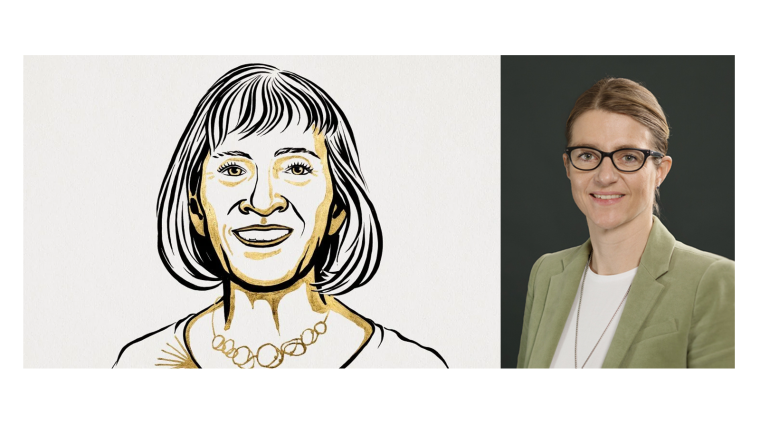
Left: Prof. Christos Koulovatianos (University of Luxembourg); Right: STATEC Research
Today, Robert E. Hall from Stanford University and Michael Woodford from Columbia University in the US have receive the Sveriges Riksbank Prize in Economic Sciences in Memory of Alfred Nobel “for microeconomic foundations of macroeconomic stabilisation”. By helping to build economic models around the real-life choices of households and businesses, their work made it easier to understand economic ups and downs and gave policymakers more reliable tools for forecasting crises and testing how measures such as interest-rate changes or tax cuts might affect and benefit us all.

We spoke to Prof. Christos Koulovatianos, Professor in Economics at the University of Luxembourg and to three researchers from STATEC's Research Division (Chiara Peroni, Francesco Sarracino, Xi Chen), about the importance of the Nobel laureates' work and how it relates to their own research.


Photo: Prof. Christos Koulovatianos (University of Luxembourg); STATEC Research Division (STATEC)
Interview Prof. Christos Koulovatianos (University of Luxembourg)
Why is the work by Robert Hall and Michael Woodford important for economic research?
Christos Koulovatianos: Hall and Woodford helped economists design policies for markets in which people react to information about the future, even though these expectations cannot be observed directly.
To understand this, let’s consider the following two examples: Today is Monday. If a flood is predicted on the Moselle on Friday, the authorities may decide to evacuate houses in order to minimise damage, but the flood will still arrive on Friday. This is forecasting.
Let’s now assume, that a major stock market crash is predicted on Friday. If enough people internalise this, tomorrow morning stock markets will trade in panic and the stock market crash will occur on Tuesday, not on Friday.
What is the difference between these two examples? It lies in how subject and object are related or not. In the first case, the subject – us – and the object – the weather – are unrelated; our actions do not change the weather. In the second however, the subject – all of us – and the object are absolutely interrelated and our decisions and actions shape the market outcome.
The same mechanism applies to oil supply and things that happen at the strait of Hormuz or the Red Sea. News about possible future supply restrictions may lead people to buy more oil now, either to build reserves or avoid higher prices later.
The fact that subject and object are intertwined requires different analytical tools. The Nobel Prize is related to tackling such problems in practice. You need to invent theoretical models to quantify expectations that cannot be observed directly. Hall and Woodford developed theoretical and empirical models to estimate these expectations and predict how people will react. This is similar to physics, where models help researchers study particles or objects that cannot be observed easily.
A useful comparison is GPS, which we use on our phone with, for example, Google Maps to navigate. Just as navigation systems constantly adapt to new information, their models show how households, firms and markets adjust their decisions. So Hall and Woodford took this principle and applied it to economics. Just as navigation systems constantly adapt to new information, their models show how households, firms and markets adjust their decisions. Their work gave central banks practical tools to make forecasts and evaluate policies in an economy that reacts to news.
How did they achieve this?
Christos Koulovatianos: They wrote a series of groundbreaking papers doing both theoretical and empirical work, but especially doing what we call blind theory work. They first had to convince the academic community working in the late 70s, 80s and 90s that you can do that. This is when they were publishing their papers. And then training generations of economists to teach that in universities and also to take it to every central bank in the world in order to build their own real world model.
But I’d like to stress that they were not the ones inventing everything. They are standing on the shoulders of contemporary giants like Robert Lucas, who received the Nobel Prize in 1995, Finn Kydland and Edward C. Prescott (2004 Nobel Prize), and Thomas Sergeant (2011 Nobel Prize). These people and their Nobel Prizes gave the mathematics and the first applications. Hall and Woodford translated everything and simplified it in a way that a practitioner with a PhD in a central bank can bring this to the analysis of forecasting and policy evaluation.
They have practically influenced every department in the world in macroeconomics. They brought an analysis of expectations to the forecasting by central banks and their decisions concerning monetary policy. The BCL definitely has many versions of models by Woodford, and Hall.
How is your own research related to the topic of the Nobel Prize?
Christos Koulovatianos: They do microfounded macroeconomics which is pretty much my field of research. They did everything about it, we now better articulate parts of it. The focused area I am working on is called heterogenous agent models and household finance. One very important contribution of these models has been to bring what you call the balance sheets of households into the analysis of how the macroeconomy works – this was absent in the past – and how the banking sector interacts with these balance sheets. My own research here in the department mostly focuses on household finance, which is the role of what you call background risks, i.e. how risks that come out of labour market affect the risk-taking of households, their investments, housing decisions, etc. My work steps on the shoulders of such giants.
Do you have any personal memories of the Nobel laureates and/or their work?
Christos Koulovatianos: In October 1994, I had to do a homework about Robert Hall’s groundbreaking paper in the late 70s, which was about a reduced form econometric model out of optimality conditions. It was the first time in my life that I realised that out of optimality conditions in a dynamic programming model, you could build an econometric model. At age 22, I then sat next to Robert Hall at the 1995 Carnegie-Rochester conference in the US, and I didn’t know who he was. When I realised, I felt extremely intimated and I said to him “I have done homework on your papers”, and he replied “Ah, I hope it was not too difficult.” Ever since, I saw him many times in Boston. Robert Hall is THE person who decides in the US when a recession starts and when it ends. I also ran into him at the economics department at Stanford – it’s a guy you see all the time.
As for Woodford, he received the Deutsche Bank Prize in 2007, around the time I was a Visiting Professor at the Goethe University in Frankfurt (in 2007-2008), so I had the opportunity to meet him whilst I was there. And the Deutsche Bank Prize committee in Frankfurt was taking pride in predicting whoever was getting the Deutsche Bank Prize would get a Nobel Prize later. So, once more on this occasion, as was the case with Eugene Fama and Robert Shiller, they were right!
What do you particularly like about the Nobel laureates' work?
Christos Koulovatianos: Hall recently demonstrated a connection between the stock market and unemployment. But not what happens every day on the stock market but what we call low frequency ups and downs of the stock market. The stock market sometimes is sometimes mostly appreciated (overheated) and sometimes under evaluated (cooled down). He suggested that every time you have an underevaluation of the stock market there will be unemployment. In both cases, there are particularstabilisation tools to deal with that. You could increase or decrease taxes or you could do public infrastructure work along the business cycles. Both of them have new recommendations about fiscal and monetary policy stabilization tools.
What I particularly like about their research is they broke old misunderstandings about the size of multipliers, about how effective those interventions would be. They let everybody re-evaluate the effectiveness of those policies. Before them, before the prevalence of those models, these interventions were thought of being much more effective than they are and less expensive. They brought that into a more realistic perspective.
They have not suggested all those models that are based on past econometric evaluation of aggregates of national accounts, but practically they brought what we call microfoundations to the models, which essentially made all of us – now that we have easy access to cross-sectional data about macroeconomy to essentially extend the model. It’s not exaggerated to say that all the academic community now in all central banks are injecting information from the cross-sections into models, meaning that research pool from essentially all households. The next generation of models is based on their work. It’s a direction we are irrefutably following.
Interview STATEC Research (Chiara Perroni, Francesco Sarracino, Xi Chen)
Why was the work by Robert Hall and Michael Woodford important for economic research?
Chiara Peroni/Francesco Sarracino/Xi Chen: Their work helped explain how the decisions of households and firms shape the behaviour of the whole economy, and why this matters for public policy. Hall’s research showed why consumption depends on expectations about future resources, rather than simply on current income. Woodford helped explain how monetary policy affects economic activity when prices do not adjust immediately, and why expectations about future policy matter alongside today’s interest rate. The important message of their joint work is that governments and central banks must consider how people interpret and respond to their actions, including considering individual biases and limited rationality.
How is your own research related to the topic of the Nobel Prize?
Chiara Peroni/Francesco Sarracino/Xi Chen: Our research relates to the Nobel prize topic through the relationship between individual well-being and aggregate economic outcomes. Although we do not study monetary policy, we investigate the conditions under which economic growth improves lives, the role of social capital and inequality, as how well-being contributes to economic performance. We have found that the long-run relationship between growth and life satisfaction depends on social trust and income inequality. We have also shown that income and social comparisons are less strongly associated with well-being among people with stronger social capital. These findings suggest that the benefits of income depend partly on the social conditions in which people live, and that the way economic activity is organized can make for good and sustainable lives or destroy the foundations of a prosperous future. Defensive growth provides another connection. People sometimes increase spending to compensate for deteriorating conditions: buying air conditioning to cope with heat, for example, or private substitutes for declining public amenities. These purchases can provide relief, but higher expenditure does not necessarily mean that life has improved relative to the situation before the damage occurred. This matters for macroeconomics because the reasons behind consumption affect how we interpret economic performance. Our work helps us distinguishing economic activity that improves lives from activity that compensates for losses. In addition, research on well-being and productivity suggests that better lives can strengthen productive capacity. In the neo-humanist perspective we developed, well-being is therefore both an objective of economic policy and a resource supporting a more resilient, socially and environmentally sustainable economy.
Morever, while this year’s prize recognises Hall’s contribution to the microeconomic foundations of macroeconomic stabilisation , we should also remember his substantial contribution to productivity research and his pioneering work on mark-ups.
These insights are particularly relevant to our work on productivity. They help us interpret productivity changes over time while recognising the role of market power, demand and production conditions. Hall’s contribution provided a foundation for studying productivity, innovation and competition together. This work has shaped and impacted directly and indirectly our research, including the analysis of the links between competition and innovation, and the analysis of productivity.
What do you particularly like about the Nobel laureates’ work?
Chiara Peroni/Francesco Sarracino/Xi Chen: What we particularly appreciate is the effort to connect economic policy with the decisions and expectations of people, thus making economics more “human”. Policy operates through households and firms, whose responses can reinforce or weaken its effects. Despite this, the focus of this work remains still very narrow: people’s decisions depend on more than income, consumption and leisure. Social relationships, trust, health, comparisons with others and environmental conditions also matter and shape individual decisions. These factors influence both economic behaviour and the quality of life that economic policy should ultimately serve.
In addition, the work of Robert Hall and Michael Woodford is relevant because their policy recommendations emerge from carefully developed microeconomic foundations. Their analysis starts with the decisions of households and firms: how people spend and save, how firms produce and set prices, and how expectations about the future shape these choices. This creates a clear connection between individual behaviour and the functioning of the wider economy. We particularly value this connection between rigorous theoretical reasoning and practical policy questions.
And finally, what stands out to me about their work is the question it raises about how we connect individual decisions with the functioning of the economy. From the perspective of my research, this leads to a fundamental question: what do we need to know about people to build useful economic models?
Income and expectations clearly matter, but so do relationships, trust, health and the environment. Their contribution provides an important starting point for this discussion, even when my research leads me towards a broader understanding of human well-being.
More information about this Nobel laureates' work on the website of the Nobel Prizes.
Questions: Michèle Weber (FNR)
Answers: Christos Koulovatianos (University of Luxembourg), Chiara Perroni, Francesco Sarracino, Xi Chen (STATEC Research)
Cet article fait partie d'une série
- 1 / 4 Nobel Prize in Medicine: Reactions from Scientists in Luxembourg Lire
- 2 / 4 Prix Nobel de physique: Réaction d’un astrophysicien du Luxembourg Lire
- 3 / 4 Nobelpreis Chemie 2026: Antworten auf ein Jahrhundert altes chemisches Rätsel Lire
- 4 / 4 Research in Luxembourg on the topic of the Nobel Prize in Economics En lecture